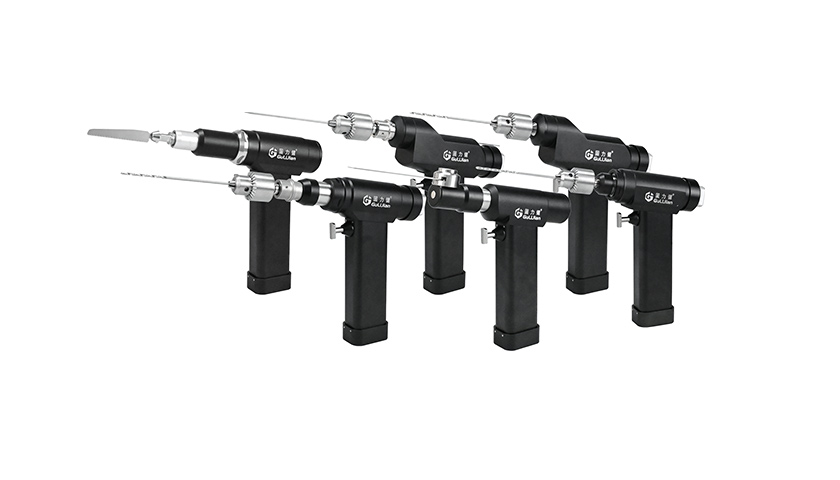
The orthopedic drill saw is a core surgical power tool widely used in trauma, spine, joint and orthopedic reconstructive procedures. Designed to cut, ream and shape bone tissue accurately, it balances cutting efficiency with patient safety, greatly supporting minimally invasive and open orthopedic operations.
Modern orthopedic drill saw systems normally consist of a handheld motor host, interchangeable saw blades and drill bits, battery packs and control modules. Surgeons can switch between drilling, oscillating sawing and reciprocating cutting modes according to surgical needs. High-frequency low-amplitude oscillation helps reduce heat buildup on bone, minimizing thermal necrosis that may delay healing. Ergonomic lightweight handles lower hand fatigue during long surgeries, while anti-slip designs deliver stable control.
Strict biocompatibility and sterilization requirements dominate its manufacturing standards. Most components are made of medical-grade stainless steel and high-strength engineering plastic, capable of withstanding repeated autoclave sterilization. Advanced models integrate speed adjustment and overload protection. When excessive resistance occurs, the machine automatically slows down or stops to avoid accidental injury to surrounding nerves, blood vessels and soft tissue.
These devices are essential for many common operations, including fracture fixation, osteotomy, bone tumor resection and joint revision surgery. Reliable orthopedic drill saws help shorten operation time, reduce intraoperative bleeding and improve surgical consistency. As orthopedic surgery advances toward minimally invasive techniques, manufacturers keep optimizing vibration suppression, noise control and power stability. The continuous upgrade of orthopedic power tools remains vital to lifting clinical outcomes and promoting safer bone treatment worldwide.