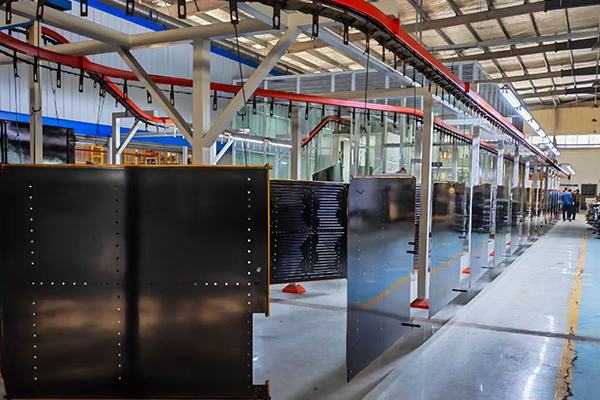
Battery Pack Cooling Plates: Why They Matter
As electric vehicles (EVs) gain broad adoption worldwide, the performance and safety of battery packs become critical. Among the components that ensure optimal battery operation, the battery-pack cooling plate plays a central role. Its primary task is to regulate temperature, preventing overheating, extending battery life, and maintaining efficient powertrain performance. This is especially important because lithium-ion batteries function best within a relatively narrow temperature range (roughly 20–40°C). If temperatures deviate beyond this range, the pack can suffer reduced capacity, slower charging, or even increased risk of thermal runaway.
Cooling Plate Technologies: Liquid vs. Air Cooling
Battery pack cooling plates mainly use one of two cooling technologies: liquid cooling or air cooling. Liquid-based cooling systems dominate in high-performance EVs. In such systems, coolant — commonly a mixture of water and glycol — circulates through internal channels in the cooling plate. As the coolant flows, it absorbs heat generated by the battery cells during charging or discharging, then carries that heat to a radiator where it is dissipated.
By contrast, air-cooling plates rely on forced airflow to extract heat. However, because air has much lower heat-transfer efficiency than a circulating liquid, air cooling is usually limited to low-power EVs or mild-hybrid vehicles. In many high-power applications, air cooling simply cannot keep up with the thermal load under high charge or discharge rates. Advanced liquid-cooling designs often use microchannel structures that increase the surface area in contact with battery cells. These microchannels can boost heat-exchange efficiency by as much as 30 percent compared with traditional designs.
Material and Manufacturing Considerations
Selecting the right material for cooling plates involves balancing several factors: thermal conductivity, lightweight construction, and corrosion resistance. Aluminum alloys are most widely used because they offer excellent thermal conductivity (approximately 205 W/m·K), low density, and cost effectiveness. For premium or heavy-duty applications, some manufacturers opt for stainless steel or composite materials — for example aluminum-magnesium alloys — to meet demands such as higher pressure resistance or operation in harsher environments.
To realize complex internal channel geometries, manufacturers typically employ precision stamping, brazing, or even additive manufacturing (3D printing). These methods help to ensure uniform coolant distribution and minimize temperature variation throughout the battery pack.
Emerging Innovations and Trends
Cooling plate technology continues to evolve rapidly. Integrated designs that combine the cooling plate with the battery tray reduce overall weight, simplify assembly, and improve structural rigidity. Smart cooling systems, connected to the vehicle control unit, dynamically adjust coolant flow based on battery temperature and real-time load conditions, enhancing thermal regulation under variable driving scenarios.
Moreover, as the industry moves toward high-energy-density battery technologies (such as future solid-state batteries), there is growing demand for thinner, more thermally responsive cooling plates. These must accommodate tighter packaging constraints while delivering high heat dissipation performance.
Conclusion
Battery-pack cooling plates are essential for unlocking the full potential of electric vehicles. By regulating temperature, they directly influence battery safety, longevity, and overall vehicle performance. As EV technology continues to advance toward higher efficiency and longer range, cooling plate designs — combining advances in material science, structural engineering, and smart control systems — will remain a cornerstone in enabling next-generation electric mobility.