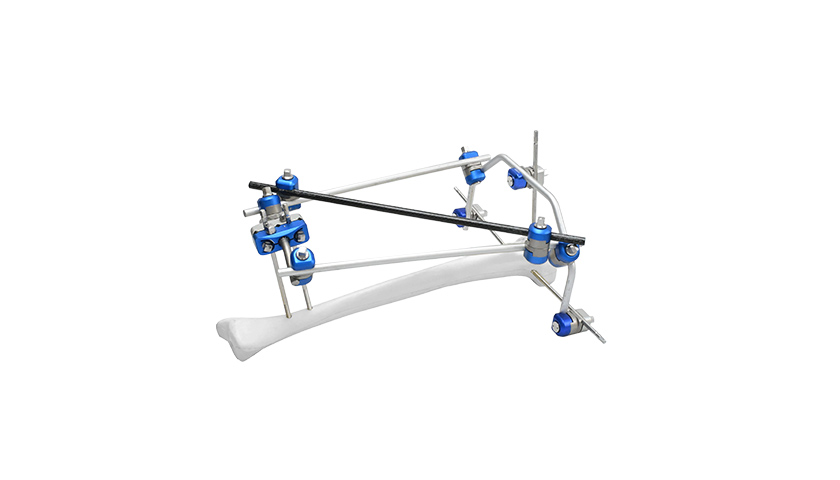
The hybrid external fixator represents a significant advancement in orthopedic trauma care, offering a versatile and effective solution for stabilizing complex fractures. Combining the principles of both circular and linear frame fixators, this innovative device provides enhanced stability, allowing for controlled anatomical alignment and early mobilization of patients. Its design, which incorporates both rings and rods, enables surgeons to address a wide range of challenging orthopedic conditions, from severe open fractures to cases involving significant bone loss or deformity.
One of the key advantages of the hybrid external fixator is its ability to provide rigid fixation while maintaining soft tissue integrity. By distributing the forces of fixation across a larger area, it minimizes the risk of pin tract infection and other complications often associated with traditional fixation methods. This is particularly crucial in the treatment of open fractures, where preserving the delicate balance between stability and soft tissue viability is paramount. Additionally, the modular nature of these fixators allows for adjustments and modifications as the healing process progresses, ensuring optimal alignment and compression at the fracture site.
The use of hybrid external fixators has revolutionized the approach to treating complex fractures, particularly in cases where internal fixation is not feasible or would be detrimental. For instance, in patients with severe comminuted fractures or those with compromised bone quality due to osteoporosis or other pathological conditions, these fixators offer a reliable alternative. They also play a crucial role in the management of fractures associated with compartment syndrome, where the ability to quickly decompress the affected limb while maintaining stability is essential. By providing a stable and flexible framework, hybrid external fixators facilitate the healing process, reduce the risk of malunion or nonunion, and ultimately improve patient outcomes.
In conclusion, the hybrid external fixator has emerged as a cornerstone in the armamentarium of modern orthopedic surgery. Its unique design, which merges the best features of circular and linear fixation systems, provides surgeons with a powerful tool to manage even the most complex fractures. By enabling precise anatomical reduction, maintaining soft tissue health, and allowing for early functional rehabilitation, these devices significantly contribute to the recovery and quality of life of patients suffering from severe orthopedic injuries. As technology continues to advance, the hybrid external fixator is likely to see further refinements, solidifying its position as an indispensable tool in the field of orthopedics.